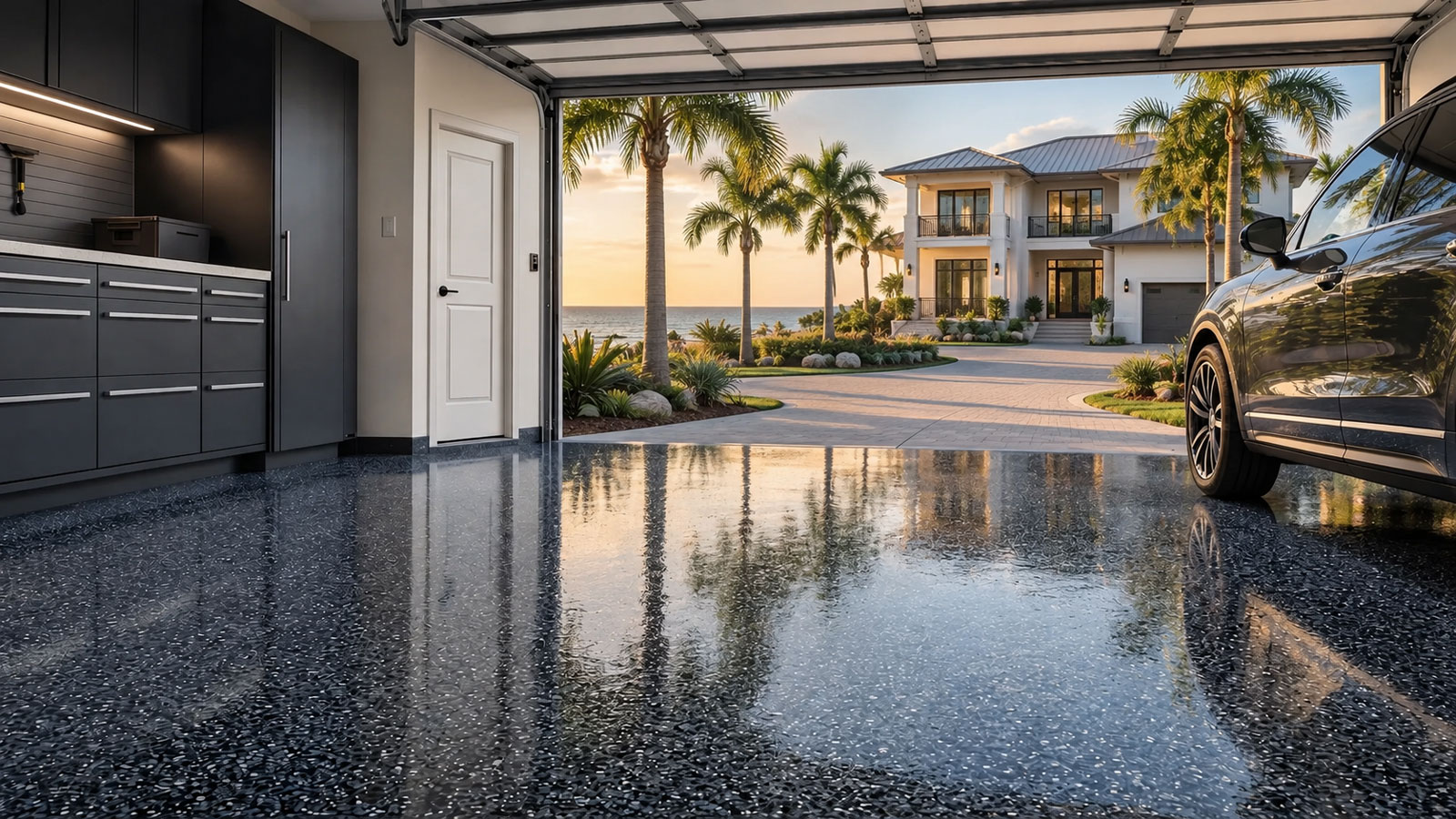
Garage Floor Coating in Fort Walton Beach, FL
Explore epoxy, polyaspartic and decorative-flake systems with Fort Walton Beach's coastal drainage conditions in mind.
Floor Coating Services in Fort Walton Beach, FL
Fort Walton Beach has a distinct municipal planning history on the northern shore of Santa Rosa Sound. Its 2019–2029 Comprehensive Plan was adopted in May 2019 and amended in November 2024, with an effective date of January 2025. The city also publishes a 2026–2036 plan and separate Coastal Management and Infrastructure elements. These public documents address a built-out coastal community rather than a generic resort area; they do not reveal the condition of any particular garage slab.
The earlier coastal-management element specifically describes tidal influences that can limit some stormwater outfalls and calls for implementing a 2013 Stormwater Master Plan. The city's current project dashboard also lists a Martisa Road NW stormwater improvement project completed in 2025. This is meaningful local evidence for asking about driveway runoff and water-entry history, but it does not prove that a homeowner's garage receives tidal water or has moisture in its concrete.
Fort Walton Beach shares the western Panhandle's warm, humid and rainy climate. A nearby Pensacola normal shows 68.31 inches of precipitation annually and a 91.6°F average July high. Epoxy, polyaspartic and decorative-flake systems may all be suitable when the slab is sound and properly prepared. Inspect existing finishes, cracks, oils, temperature at open thresholds and actual maintenance needs before choosing a finish or scheduling the return of cars.
Local Market Insight
Fort Walton Beach's 2019 plan identifies tidal impacts on some outfalls, and its updated comprehensive planning and 2025 Martisa Road NW stormwater work provide specific infrastructure context. A private slab still requires inspection.
What Affects the Cost of Garage Floor Coating in Fort Walton Beach?
Fort Walton Beach garages can differ in concrete history, coastal proximity and building arrangement. Prior finishes, pitting, repairs, access and actual wetting are better cost predictors than a broad coastal-market label.
Ask the contractor to explain how the slab will be cleaned and profiled, what repairs are included and whether water-related problems need independent work before coating.
- Previous coatings: Paint, sealers and failing epoxy may need removal and mechanical preparation. A new topcoat cannot correct a weak bond underneath.
- Damage and repairs: Pitting, cracking, repairs and deteriorated edges change scope. Any serious or moving concrete problem warrants proper assessment.
- Entry drainage: Tidal outfalls and city stormwater projects are public infrastructure facts. Only the property shows whether water crosses a particular driveway or threshold.
- Contaminants from use: Sand, parking oils, equipment and cleaners can require extra preparation. Salt residue should be addressed if present, not assumed by address.
- Floor and edge geometry: Drains, steps, irregular bays, stored belongings and vertical surfaces affect installation labor beyond area.
- Coating and timing: Decorative texture, topcoat, humidity, sun exposure and curing conditions affect both appearance and safe return to vehicle use.
Call for a clear, project-specific estimate — or request one online.
Fort Walton Beach Coastal Planning and Real Garage Water Conditions
Fort Walton Beach adopted its 2019–2029 Comprehensive Plan in May 2019 and amended it in November 2024, effective January 2025. Its coastal-management policies address storm surge, high tides, stormwater runoff and related sea-level concerns. A 2013 Stormwater Master Plan was also intended to identify outfalls affected by high-tide conditions. These municipal planning facts are distinctive to the coastal city, but they cannot diagnose whether a particular garage slab is damp.
The city maintains its own stormwater and roadway functions, with a public hotline for drainage issues. Its project dashboard lists Martisa Road NW stormwater improvements as completed during 2025. Meanwhile, 2026 traffic studies for Elliott's Point and the Northwest neighborhood show the city continues to work on local access and street issues. None of these city projects should be represented as a repair or hazard at an unrelated private home.
At the garage, ask about roof water discharge, driveway grade, recurring water marks beneath the door and wet areas that persist when outside surfaces are dry. If exterior runoff is the problem, a coating cannot fix grading. If there is suspected moisture moving through concrete, further assessment or testing may be necessary before a low-permeability finish is applied.
A useful contractor proposal separates preparation, damage repair, testing where appropriate, coating layers and any excluded drainage work. Homeowners should record actual previous flooding or water-entry history if it exists, but should not be told that every waterfront or inland garage has the same exposure.
Santa Rosa Sound Climate, Surface Preparation and Maintenance
Fort Walton Beach's coastal setting makes salt and humidity reasonable topics for questions, not automatic conclusions about the slab. Some garages remain sheltered; others receive sand and wind-blown moisture at an open entry. The appropriate response is to inspect the actual surface for deposits, stains, previous finishes and signs of deterioration, rather than specify a coating solely from distance to the Sound.
Pensacola Regional Airport's 1991–2020 normals provide a nearby climate benchmark of 68.31 inches of annual rainfall, including more than seven inches each in June, July and August. Warm, humid weather can affect surface preparation and curing, and a sunlit outer slab may be hotter than interior concrete. The installer should follow the complete coating manufacturer's temperature and moisture limits.
A well-prepared coating may offer easier cleanup than porous unfinished concrete. It does not eliminate tracked-in road grit, sand, oily spills or standing water. Discuss the intended use, maintenance habits and level of traction required. A smoother finish can wipe more easily, while more aggressive flake texture may be better suited to wet footwear but need firmer scrubbing.
If old epoxy or paint is peeling, it needs evaluation and possibly removal before a new finish. A glossy replacement layer alone will not improve adhesion to a defective previous coating. Cracks, patched areas and serious concrete movement also deserve appropriate repair or separate assessment.
Ask for a written timeline from clearing the garage through grinding, repair, coating application, finishing and cure. In a busy household the safe return-to-parking date can matter as much as color and texture.
Frequently Asked Questions
Do tidal outfalls mean every Fort Walton Beach garage is wet?
No. City planning documents describe challenges in public stormwater infrastructure. Your garage requires its own inspection for water entry, persistent dampness and concrete condition.
Will a coating protect against flooding from Santa Rosa Sound?
No. Decorative garage-floor coatings do not stop coastal flooding, correct drainage or provide structural flood protection. Such concerns need a separate property-specific approach.
Should salt deposits be removed before coating?
If deposits or contamination are present, they should be identified and handled during appropriate preparation. Salt damage should not be assumed merely because a property is near the water.
How does the summer weather affect my project?
Warm temperatures, humidity and rain can affect surface conditions and cure windows. Ask the installer to follow the system's application specifications and provide a realistic vehicle-return date.
What should a Fort Walton Beach coating estimate include?
The quote should describe inspection, prior-finish removal, grinding, repairs, full coating layers, traction choices, edge detailing and realistic curing guidance.
Fort Walton Beach Neighborhoods & Local Context
Phone Quote Line
Speak with a floor coating specialist about your project and get a realistic estimate range.
(850) 789-7227Typical Project Cost
$3,000-$5,500
Typical planning range for a two-car garage. Final pricing depends on floor size, concrete condition, prep work, coating type, and finish options.
Helpful Guides
Other Service Areas